

| SNEAK PEEK |
— Why Boeing is just another example of an industrial giant coming unstuck because of financialisation.
— Ireland’s renewed Celtic Tiger boom is not what it seems.
— Dario digs into the new trade routes being opened up by the thawing of the Arctic and how the key powers are positioned to take advantage of it.
Good morning subscribers! It’s been a fairly busy week, what with TikTok bans, operational framework reviews at the ECB and mystery obelisks appearing in Hay-on-Wye in Wales (I swear I had nothing to do with it!). But you can read about those almost everywhere. (There weren’t too many surprises out of Frankfurt btw). As usual, we’ve got our sights focused elsewhere.
This week’s newsletter was brought to you by me, Izabella Kaminska, with the help of my trusty accomplice Dario Garcia Giner. No changes there!
Send tips to [email protected] and [email protected]
| THE BIG BLIND SPOT THIS WEEK |
TUPOLEV BOEING: Will Boeing’s troubles ever end? The latest incident, one of six in the last 10 days, saw a Boeing 787 pilot lose control of a LATAM flight from Australia to New Zealand due to a malfunctioning instrument. But the worrying thing is that the incidents are no longer isolated to the airline’s troubled 737 Max 9 range. More worrying still, a key Boeing whistleblower, John Barnett, was found dead – supposedly killed by a self-inflicted gunshot – just before he was due to take part in a deposition about his safety whistles.
Suspicious circumstances: To raise suspicions further, a friend of John Barnett allegedly claimed the whistleblower had warned her that if he was killed, “it’s not suicide, don’t ever believe it” just days before his death.
Some of Barnett’s allegations were shocking, including that workers were failing to follow major operational procedures. Components couldn’t be tracked throughout the factory, allowing defective parts to go missing. In some instances sub-standard parts were being removed from scrap bins and fitted to planes being built to prevent delays. For those of you who saw the leaked video of Boeing engineers in 2014, where most claimed they would never fly on their 787 Dreamliner, this checks out. The workplace was also infested with drug use: “you can buy great weed here” said one employee.
But are things really that bad or are we merely more tuned in to picking up bad news from Boeing? The data still (just about) suggests that the overall safety trend is steady. “There’s not anything unusual about the recent spate of incidents — these kinds of things happen every day in the industry,” pilot and president of Guzzetti Aviation Risk Discovery LLC, Jeff Guzzetti, told CNBC. But that doesn’t mean there’s not a growing risk that things change soon.
DID BOEING BECOME OVERLY FINANCIALISED? Those in the know say is it all began to go wrong with Boeing’s 1997 merger with McDonnell Douglas. Even though Boeing was the larger company, it was the culture of McDonnell Douglas that came to dominate the merged entity, in part because of MD’s financially-driven incentive structures and the dominance of its financial segments, among them McDonnell Douglas Finance, later to be renamed Boeing Capital. This, supposedly, saw the company take its eye off the engineering ball, culminating in the cost and competition pressures which eventually led to the bad decision making behind the faulty Boeing 737 Max design.
How the money men took over: As the Atlantic wrote in 2019: “For about 80 years, Boeing basically functioned as an association of engineers. Its executives held patents, designed wings, spoke the language of engineering and safety as a mother tongue. Finance wasn’t a primary language. Even Boeing’s bean counters didn’t act the part. As late as the mid-’90s, the company’s chief financial officer had minimal contact with Wall Street and answered colleagues’ requests for basic financial data with a curt “Tell them not to worry.’” But then suddenly it all changed.
You need to become a bank: In 1999 the New York Times reported on the shift of priorities happening at Boeing quoting an analyst at JSA Research: ”Boeing in the past kept saying, ‘We make airplanes — we’re not a bank, but I think they have to be.”
Finance pushes in: Boeing Capital evolved as a lender of last resort to poorer airlines which could not afford to buy airlines outright or lease them from the usual providers. More broadly, MD’s culture and focus on balance sheets, financial targets and PNLs came to dominate almost all activities at the airplane maker.
Following in Westinghouse’s footsteps? This is not the first time an engineering company has lost its way after becoming overly financialised. Pittsburgh Post journalist Steve Massey chronicled how Westinghouse’s demise was connected to similar financialisation forces, notably the rise and fall of Westinghouse Credit and its Financial arm. (Hat tip to A).
“Westinghouse Credit’s stunning fall was equaled by its stunning ascent during the late 1980s, when Danforth and his successor, John Marous, transformed the formerly low-profile unit, which once just financed appliance purchases, into a speculative commercial real estate and corporate lending vehicle that promised fast growth and fat profits. The mess left behind by the collapse of the credit unit overwhelmed Paul Lego, the CEO who succeeded Marous. Like other finance companies, Westinghouse Credit was virtually unregulated and proud of it. It liked being a lender of last resort. It welcomed deals its regulated brethren, banks and thrifts, couldn’t or wouldn’t do. And for good reason: it go hefty upfront fees and charged high rates.”
Boeing’s fatal flaw: Don’t miss this excellent PBS documentary about the whole sorry saga.
| BUSINESS, ECON AND FINANCE |
SPEAKING OF AIRCRAFT LEASING: Independent banking consultant and former aircraft financing veteran, Bob Lyddon, fears the Irish economy has over-exposed itself to aircraft leasing and there could be consequences for the whole economy if the push for a global minimum corporate tax threshold of 15 percent is finally set into motion, undermining Ireland’s edge.
But, but, but: Ireland is currently wooing Northern Ireland to peacefully reunify with the mainland on grounds that its economy is defying Europe’s wider economic malaise and that it is once again reestablishing itself as a Celtic Tiger.
What’s not being mentioned: How dependent the current boom is on corporate tax arbitrage (and thus how fragile it may be.)
The Irish reunification factor. Yep, it was news to us too. But apparently Irish PM Leo Varadkar is surer than ever that a peaceful political pathway to Irish reunification exists, and has been openly saying as much for months. The idea that Ireland’s economy is sizzling while Brexit Britain is languishing is central to the appeal.
“From basket case to economic pin boy”, is how the Telegraph described Ireland’s resurgence last year. Most analysts agree the outlook is rosy, with GDP expected to rise by 2.2 percent in 2024, and a further 3.8 percent in 2025.
No hubris here: Ireland has said it wants to roll out a dedicated Sovereign Wealth Fund by 2030 to capture all those economic gains for its people. But as Lyddon points out, the move also hints authorities know just how susceptible the model will be to ‘base erosion’ over the years and how fleeting the boom may be.
“On closer examination, the figures that support the existence of this ‘Celtic Tiger’ are cooked up, and the greater part of the economy depends on magicking away corporation tax for foreign multinationals. The efforts of Ireland’s greatest brains are squandered on tax avoidance – albeit on a world record scale.”
But what’s it got to do with aircraft leasing? According to Lyddon about 70 percent of the world’s commercial airliner fleet is owned by Irish entities. The structure allows for “huge depreciation allowances that are made available to the Irish subsidiaries of multinationals and which further reduce their pretax profits and corporation tax bills.”
Modified Gross National Income: So skewed are the figures behind the Irish economy by the whole business of attracting inflated invoices onto its shores, that the Irish government even issues its own preferred metric for GDP to cut through the noise. So-called “modified gross national income” purports to strip out all activity relating to foreign multinationals. Yet, according to Lyddon, the measure is not what it seems since it fails to segregate depreciation effects from intellectual property and aircraft leasing.
“Aircraft leasing is a key component in the tax-sparing model for foreign multinationals. It should not therefore be counted within MGNI — the supposedly free-standing portion of the Irish economy that is not tied into foreign multinationals.”
Misleading figures: Overall, Lyddon says, corporate tax-related activity comprises 65 percent of Ireland’s economy and is responsible for most of the country’s high-paid employment. That means if Ireland were to lose tax competitiveness it wouldn’t take much to turn the Celtic Tiger into an endangered species.
How does the leasing work? Via Lyddon: “An aircraft is purchased from Boeing or Airbus by a specially-incorporated legal entity in Ireland. The type of entity is chosen such that a separate and existing legal entity can claim depreciation allowances on the aircraft and use them to reduce their corporation tax. This legal entity need only inject a fraction of the purchase price of the aircraft in order to claim the entirety of the depreciation allowances. The remainder of the purchase price is raised through debt.”
Bottom line: Lyddon says the amount of economic activity tied up in Ireland with foreign multinationals is closer to €464.5 billion than the €253.9 billion officially derived from the difference between GDP and MGNI by Irish authorities. That presents the risk that if the people of Northern Ireland ever do decide to jump ship and join the mainland, rather than benefiting from economic growth, they might be left holding the bill for yet another ill-thought-out episode of Irish opportunism.
| RUSSIAN ASSETS |
REDIRECTING PROFITS TO BUY BULLETS: European Commission President Ursula von der Leyen has been fronting a campaign to persuade EU members to pivot on the original plan to use the profits derived from Russian assets sitting at Euroclear in Belgium for Ukrainian reconstruction and to deploy them instead to source ammunition for Ukraine’s ongoing war.
Not amused: Politico reported that Hungary, Slovakia, Malta and Luxembourg pushed back against the idea during a meeting of the European Union’s 27 ambassadors on Wednesday, arguing the discussions might be a signal of what is to come during an EU summit next week, when leaders hope to decide on how to use the proceeds of the assets that have been immobilised in Europe since Russia’s invasion of Ukraine two years ago.
Rogue behaviour: Hungary and Slovakia — widely seen as Russian President Vladimir Putin’s best friends in the EU — oppose purchasing weapons as they don’t want to contribute to what they see as a military escalation in Ukraine. Others share the goal of supporting Kyiv but are frustrated by von der Leyen’s tendency to propose radical ideas without any prior consultation with national capitals. “There is a growing discontent against von der Leyen for improvising,” said an EU diplomat.
ESG is compatible with defence: For countries like Malta, purchasing ammunition for Ukraine clashes with its decades-old neutrality policy that prevents it from buying lethal weapons for foreign countries. There are also legal concerns that it might be difficult for countries like Malta to secure opt-outs for buying deadly arms, according to a second diplomat. But, these setbacks should be seen in the context of a wider push to destigmatise the funding of arms more broadly, especially in the context of ESG investment.
This is no Libya situation: Some are wondering what’s the bother when Euroclear has a track record of releasing funds for much dodgier purposes. For example, profits derived from Libya’s assets — frozen in 2011 — were released by Euroclear into the hands of LIA and LAFICO accounts in Luxembourg and Bahrain. But that situation, arguably, was different. The objectives of the sanctions was to dis-empower the Gaddafi regime, which no longer exists. The main reason the assets are still frozen is because of competing claims over control of the country and ongoing political instability.
WHAT ABOUT THE DARK ASSETS? The UK’s share of Russian assets is said to be worth between £10-20 billion. But is that really the limit of Britain’s potential trove? Some estimates put Russia’s dark assets abroad at over $1 trillion. While most of the crown dependencies and overseas territories say they are fully cooperating with enforcing sanctions, the real question is whether an industry that prides itself on obscuring ultimate beneficial owners of assets is really capable of enforcing such policies. Thus far, information sharing between jurisdictions is still not happening. Indeed, Britain’s dark asset industry scored major win in November 2022 when the Court of Justice of the European Union ruled beneficial ownership registers were incompatible with human rights.
Privacy collateral damage: But while a number of European jurisdictions have already withdrawn their registers from public view, the battle over how beneficial ownership transparency will be enforced by Britain’s offshore centres will only be played out over the course of 2024.
Selective access only: British crown dependencies and overseas territories, empowered by the ruling, have for now backtracked on any full transparency. According to a public commitment issued at end of December 2023, they are instead prepared to open up their beneficial owner registers to “legitimate interests” only, such as police authorities and journalists. The UK on its part, is yet to determine how it will adjust to the European court ruling. For now, its beneficial ownership registers remain public. Individuals can, however, apply to have information about beneficial ownership suppressed if they can prove their physical safety is at risk because of the disclosure.
Not tested in court. Whether that policy squares with individuals’ fundamental rights to privacy as enshrined in Articles 7 and 8 of the Charter on Fundamental Rights is another matter. Until the issue is tested in court, little is likely to change.
Quid pro quo? With British offshores on the verge of opening their registers to select entities any minute now, circumstances feel ripe for a backroom deal to be done. At stake is how much authorities and journalists will find, but also who does or doesn’t qualify as a journalist.
Russia: “You’re not really going to force transparency on the systems that maintain your own secret fortunes as well as ours, are you?”
The West: “Darn it. You’ve called our bluff. Okay, we will let you keep some portion of the dirty assets you pilfered from your own people, but the rest of it — the official bit — has to go back. But if we cut a deal now, we won’t tell on the rest of your dark wealth, but only if you don’t tell on ours. Okay?”
Russia: “So that’s a medium-sized haircut so that we can keep the rest?”
The West: “Pretty much.”
Russia: “And now we can end this charade about transparency and move everything over to crypto and Dubai?”
The West: “Pretty much. But don’t go thinking you’ve gotten away with everything just yet!”
Russia: “Yeah, yeah. It is but a flesh wound.”
If you’re looking for a historical precedent for this sort of stealth dealmaking with a public enemy you can’t really outgun but would rather not admit to doing a deal with, look no further than the infamous deal Pompey the Great cut with the pirates. It is largely suspected that the reason Pompey’s campaign against the Mediterranean pirates proved as successful as it did is because it involved a lot more dealmaking and paying off of the enemy than it did fighting. Domestically though, the propaganda presented it as an ingenious military triumph.
| WAR ECONOMY |
| DEEP TECH |
FUSION POWER IS NEARER THAN YOU THINK: The Telegraph’s Ambrose Evans Pritchard waded deep into contrarian energy narratives, arguing that commercial nuclear fusion has gone from science fiction to science fact in less than a decade and that most politicians are asleep to the potential energy boom that’s around the corner. AEP cited recent advances by Britain’s First Light Fusion as boding particularly well for faster development.
All about the Q factor: There have also apparently been a flurry of peer-reviewed papers confirming the news that Commonwealth Fusion Systems near Boston has broken the world record for a large-scale magnet with a field strength of 20 tesla. This takes us in the right direction of exceeding the threshold necessary for producing a net energy gain, known as a Q factor.
Does that mean free energy? Not quite. Conventional fusion still needs tiny amounts of something called deuterium-tritium, which is still pretty rare.
Billionaires at the ready: There’s a lot of money now flowing into development. Top projects in the field are backed by the likes of Bill Gates, Jeff Bezos and Sir Richard Branson. OpenAI’s Sam Altman is also in on the game, though he’s betting on a different strand of fusion technology that harks back to concepts first attempted in the 1950s but which might now stand a better chance due to associated technological developments.
WAR IS PEACE, French President Emmanuel Macron told viewers in a television address that “Europe must be ready for war if it wants peace”.
Funding the Pax Europa: Europe’s main economies may be facing a fiscal cliff, but that’s not going to stop them from restructuring themselves as defence-oriented powerhouses.
Added bonus: Doing so could help Europe solve its small fiscal fragmentation problem.
How so? Europe’s preferred way to fund its transition to a war machine is by broadening the European Investment Bank’s mandate to include defence. This will have the neat side-effect of creating a whole new pool of common eurobonds.
UKRAINE IS NOT WINNING, SAYS ESTONIA: “The potential loss of Ukraine is the closest that it has ever been. And that is a very, very scary perspective,” Kusti Salm, the Estonian defense ministry’s secretary-general, told reporters Wednesday. “The fact of the matter is that Ukraine is not winning” he added. Although, it doesn’t mean Ukraine will be defeated, he stressed (as reported by Politico).
License to raise €100 billion to kill: The two most politically palatable options to raise the €100 billion to help Ukraine win, he said, are defence bonds and changing the mandate of the European Investment Bank. The goal is to send the message that the “lethal part of [the] defence industry is investable,” he told Jacopo after the meeting. “And that would be a sort of leading message also for all the pension funds, investment funds, all other funds that are part of the financial market of Europe.”
| DEATH BY BUREAUCRACY |
EUROBOMB: Marc Andreesen said on X: “The real Eurobomb is a stifling blanket of regulation that causes deliberate decline,” in response to news Europe was considering developing a “Eurobomb” with a nuclear command-and-control suitcase that constantly “roams” between EU capitals.’
DEI KILLED THE CHIPS ACT: “Intel is also building fabs in Poland and Israel, which means it would rather risk Russian aggression and Hamas rockets over dealing with America’s DEI regime. Samsung is pivoting toward making its South Korean homeland the semiconductor superpower after Taiwan falls,” wrote Matt Cole and Chris Nicholson in an oped for the Hill.
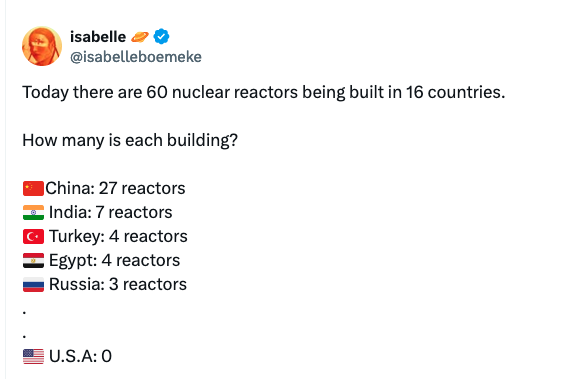
CHINA’S NUCLEAR PUSH: Beijing was able to approve as many as 10 new reactors a year, the chairman of China National Nuclear Corp. said last week, which would accelerate an already impressive expansion of atomic energy, Bloomberg reported. Meanwhile:
| NEW GEOGRAPHY |
DARIO COMMENT: For the first time, Finland joined the NATO Arctic drill called “Cold Response” as a full NATO member last week. These drills emphasised the increasing importance of the High North as an “important and strategically located area” for NATO. Some quick measuring on a map clearly shows the Arctic is the shortest transit area for missile and troop attacks into both the United States and Russia.
But is that all the High North is? More than a strategically relevant zone for militaries, the High North is shifting from an ice-cold region of nothing to an increasingly busy waterway. In a time where the navigable choke-points of international trade are becoming increasingly cluttered and dangerous — like the Panama or the Suez Canals — we should start looking north.
And, as you can imagine, so are China, Russia and the United States.
The first thing you should know is that there are three routes which transit through most of the Arctic Circle:
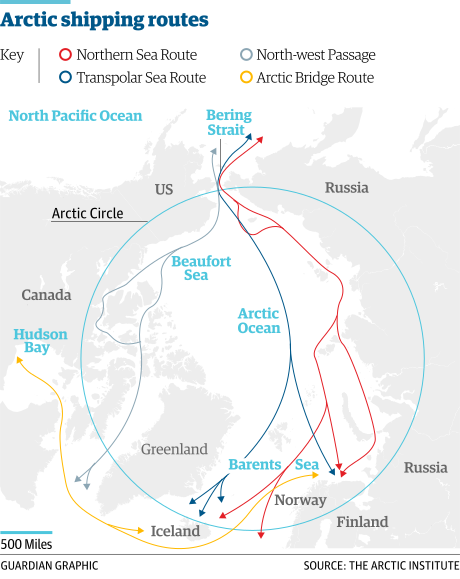
Of these, only two are navigable at all: the North West Passage (NWP) and the Northern Sea Route (NSR). The other — the Transpolar Sea Route, is only navigable with a nuclear-powered icebreaker even in the peak of summer. As the map suggests, the NSR is controlled by Russia, while the NWP transits through the jurisdictions of the United States, Canada and Denmark.
Fascinatingly, transit times across these northern routes — when they’re not covered with ice — tend to be significantly faster for many critical shipping routes than the mainstream alternatives around the Canals.
For instance, a ship travelling from Dalian, China to Rotterdam, Netherlands will arrive at port in 33 days using the NSR, versus 48 days with the Suez Canal. And with the vanishing ice fields across the Bering Sea, the Chukotka Sea and the East Siberian Sea, the NSR and NWP are becoming navigable across a greater part of the summer months. Some scientists even project that by 2035 the Arctic may be free of ice during the summer months. That may be why the Emirati firm DP World announced a joint venture with Russia in October 2023 to develop Arctic container shipping, with Indian officials meeting with Russia to discuss a similar deal.
As you can imagine, this melting is setting off a global firestorm of attention for the Arctic routes among global powers — one I was totally unaware of until recently. And it makes several events come into perspective. The first is the Russian push for a revival of its Arctic zones of control and the Russia-China alliance.
While the Soviet Union inaugurated the NSR in the 1930s, its ice coverage meant it was never a reliable transport route. But now Russia is taking full advantage. It has reopened around 50 Soviet military bases that crisscross its Arctic frontier and envelop the NSR — including 13 air bases, 10 radar stations, 20 border outposts and 10 emergency rescue stations. These bases also include the deployment of special forces units that form part of a reformed and strengthened Russian Arctic Brigade.
The de-icing for Russia is the icing on their cake. The NSR is now the most viable route of commerce between China and Europe, trade volumes along the route increased by 755 percent from 2014 to 2022 — and is slightly more navigable than the NWP. Furthermore, it lies squarely within its territorial waters. This means it’s not subject to the same jurisdictional squabbling between Canada, the United States and Denmark. Surprisingly, Canada and Russia are on the same side of this dispute — with both supporting each other’s jurisdictional claim to control the entirety of their respective routes. The United States and the European Union contest both.
China, on the other hand, has named itself a “near-Arctic power” and has branded the NSR its new “Polar Silk Road” — the Arctic component of its Belt and Road initiative. This critical aspect of the Russian-Chinese partnership means COSCO, a prominent Chinese shipping company, is operating around 30 percent of all voyages across the NSR. COSCO calculated that 14 voyages on this route reduced total transportation days by 220 and saved almost 7,000 tons of fuel — cost reductions amounting to almost $10mn compared to traditional routes.
But cost reductions aren’t the primary gain for China. China has long been nervously eyeing their dependence on the Indonesian/Singaporean Malacca Straits, where almost 80 percent of their oil imports pass through. In the event of a war, it means the United States could easily chop off most of China’s oil imports — leading analysts to call this China’s “Malacca Dilemma”. Increased de-icing on the NSR, however, means China could diversify its oil imports through a route that, while crossing the Bering Strait — half of which is US controlled, is closer and easier to manage by China and its Russian ally.
Naturally, the United States and Canada aren’t sitting still. While there are no deep-water ports along northern Alaska or in the Canadian archipelago, this is rapidly changing. The US is planning to build its first deep-water Arctic port in Nome, Alaska — just across the Bering Strait. And — if you’re thinking what I’m thinking — it has Donald Trump’s attempt to purchase Greenland from Denmark in 2019 making a lot more sense.
The United States must also face up to another problem — the icebreaker gap. The US currently operates one or two heavy icebreaker ships while Russia has approximately 40, including 11 nuclear icebreakers. And while Russia is now launching a new nuclear icebreaker every other year, the United States’ first is facing substantial delays and will only enter service in 2027.
Canada is building its own deep-water port in Qikiqtarjuaq in Nanuvut, which lies at the end of the NWP route. The initial investor in the Qikiqtarjuaq port in Nanuvut was, you guessed it, China, until the Canadian Federal Government ponied up $40m in development funds.
But none of this increased attention and investment will make the Arctic route an overnight success. Insurers are still extremely wary of transits across this route. Poor mapping, extreme and unpredictable weather increase the likelihood of accidents. And while time savings are neat, they don’t paint the full picture. Delays due to abundant sea fog account for 23-27 percent of sailing time along the NWP and 4-11 percent along the NSR. All of this means sailing across the Arctic requires expertise and specialist ships. It also explains why Arctic trade is still negligible — in 2022 less than 1,700 ships entered the Arctic, while 23,000 went through Suez and 14,000 through Panama.
Furthermore, Russian regulation across the NSR is stifling. One law requires all ships transiting the NSR to be piloted by Russians, requiring the payment of tolls and providing advance notice of their plans when on route. All of these are just some of the reasons — on top of the still-abundant ice cover — that shipping companies often bypass these relatively high costs and opt for the longer but more reliable option of the Suez, Panama or Cape of Good Hope routes.
But while significant costs and issues associated with the NSR and NWP remain, most will melt away if the ice cover continues to disappear. And the entry of the world’s most capable geopolitical player — the UAE — shows the route’s promise will only increase in the years ahead.
| CIVIL RIGHTS |
WHAT EVEN IS EXTREMISM THESE DAYS? British Prime Minister Rishi Sunak announced that the UK would be changing its definition of extremism. Whereas it used to define extremism as “the vocal or active opposition to our fundamental values such as mutual respect and tolerance, the new wording would shift to describing it as “the promotion or advancement of an ideology based on violence, hatred or intolerance” that seeks to achieve one of several aims.
Extremist aims include: To negate or destroy the fundamental rights and freedoms of others; to undermine, overturn or replace the UK’s system of liberal parliamentary democracy and democratic rights; or to intentionally create a permissive environment for others to achieve one of the two previous aims.
Names named: Communities Secretary Michael Gove outlined five groups that would qualify under the definition: Patriotic Alternative, the British National Socialist Movement, the Muslim Association of Britain, Cage and MEND.
Blowback? The bigger question is could any members of the current Tory government qualify as extremists under the current definition? Hard to say. The main factor seemingly preventing someone like Suella Braverman being swept under the definition is that her intolerance is targeted at protecting the UK’s system of liberal parliamentary democracy’s ability to protect tolerance. In other words, it’s ok to be intolerant if you’re doing it to protect parliamentary democracy and democratic rights more broadly. Though this creates an obvious problem in the event of any stolen election claims, when nobody can fully agree who really is protecting democracy.
| CoVId COLLATERAL DAMAGE |
VACCINE ANOMALIES: Trial Site News, a specialist media outlet covering pharma trial news, asserted there were many anomalies in the FDA’s Covid vaccine rollout, drawing on slides that showed the FDA knew early on about the many adverse health events the vaccines would trigger.
| MEDIA MATTERS |
TRUMP’S SECRET PROPAGANDA WAR. Reuters reported, citing US officials, that Donald Trump authorised the CIA to launch a clandestine campaign on Chinese social media aimed at turning public opinion against the Chinese government while in office.
KEEPING THE TELEGRAPH BRITISH: According to Politico, the government caved in to pressure to stop foreign governments buying U.K. media organisations — following a huge backlash over plans to sell the Telegraph newspaper to a UAE-backed fund.
The pledge: Culture Minister Stephen Parkinson confirmed that the government would bring forward an amendment at the third reading of the Digital Markets, Competition and Consumers Bill amending the media merger regime “explicitly to rule out newspaper and periodical news magazine mergers involving ownership, influence or control by foreign states.”
Definitions, definitions … The amendment will expand the definition of foreign power beyond that set out in the National Security and Investment Act and expand the definition of newspaper under the Enterprise Act to include news magazines, meaning Spectator journalists can sleep soundly.
HANNAH BARRON STORMED THE INTERNET: Hannah Barron is a smoking hot Alabama gal who likes catfish wrestling and manual labour, but got criticised on the internet for her Southern drawl and appearing far too man-ish. The backlash against her sparked a viral debate about whether women can be sexy and tomboyish. [The answer of course is yes.] But she may also have unwittingly ended up fulfiling an ingenious counter-propaganda role by informing young girls on the internet that just because you like Nascar or football, or like to climb trees, doesn’t mean you immediately have to start thinking about a sex change.
YEP, ELON WENT THERE: Musk’s own ‘counterpropaganda’ efforts continue to lean into increasingly less subtle assertions that the US has been subjected to a fifth-column propaganda attack focused on destabilising and demoralising its people to the point of unwitting self-sabotage and collapse. In that vein the world’s still just about richest man posted the now infamous 1984 interview with KGB defector Yuri Bezemov in which the former operative explains how ideological warfare really works.
Know your history: It’s not the first time that Bezemov’s expose of KGB propaganda techniques has been subject to a well-placed “red-pilling” amplification. Clips of the interview featured prominently in the promo for the release of Call of Duty’s 2020 “Black Ops Cold War” game. You can see it here.
If you liked Bezemov, you’ll love Golitsyn: Bezemov wasn’t the only Soviet defector to claim the USSR was engaged in the longest of long-game propaganda wars. The other was Anatoliy Golitsyn, whose theories about communist infiltrators in the US intelligence services sent CIA director James Jesus Angleton quietly mad in the 1950s. In his book New Lies for Old, Golitsyn spells out the strategy even more succinctly:
“Even those who recognise the dangers of disinformation cannot conceive that it can be practiced on so grand a scale and with a subtlety so disarming. They forget — or perhaps have never fully realised — that their predecessors were similarly deluded in the 1920s, and they fail to take into account that communist penetration of Western governments and intelligence services provides an accurate early warning and monitoring service of Western reactions to disinformation.
It is not easy, living in a democracy, to accept that total, obsessive commitment to world revolution could survive through sixty years and then be rekindled with fresh zeal.”
| GEOPOLITICAL HOT SPOTS |
US ISRAEL TENSIONS: Fears grew in Israel that the US Biden Administration might be plotting to overthrow Prime Minister Benjamin Netanyahu’s government, according to the Jersualem Post.
| DEEP TECH |
FUSION POWER IS NEARER THAN YOU THINK: The Telegraph’s Ambrose Evans Pritchard waded deep into contrarian energy narratives, arguing that commercial nuclear fusion has gone from science fiction to science fact in less than a decade and that most politicians are asleep to the potential energy boom that’s around the corner. AEP cited recent advances by Britain’s First Light Fusion as boding particularly well for faster development.
All about the Q factor: There have also apparently been a flurry of peer-reviewed papers confirming the news that Commonwealth Fusion Systems near Boston has broken the world record for a large-scale magnet with a field strength of 20 tesla. This takes us in the right direction of exceeding the threshold necessary for producing a net energy gain, known as a Q factor.
Does that mean free energy? Not quite. Conventional fusion still needs tiny amounts of something called deuterium-tritium, which is still pretty rare.
Billionaires at the ready: There’s a lot of money now flowing into development. Top projects in the field are backed by the likes of Bill Gates, Jeff Bezos and Sir Richard Branson. OpenAI’s Sam Altman is also in on the game, though he’s betting on a different strand of fusion technology that harks back to concepts first attempted in the 1950s but which might now stand a better chance due to associated technological developments.
