Where finance and media intersect with reality.

In the Blind Spot (Black Ops Capital, Daisy Chain QE, Substack)

Shutterstock_1243868884

This week’s Blind Spot Wrap was compiled by Izabella Kaminska and Dario Garcia Giner.

De-dollarisation goes mainstream:.

  • The IMF’s latest Currency Composition of Official Foreign Exchange Reserves (COFER) release showed an increase in overall positions in Q4, 2022. Kathleen Tyson of Pacemaker Global argued the data could indicate that her theory that Western central banks have been helping each other out with FX interventions in a daisy-chain process is true. Only the BoJ has thus far admitted to stealth interventions in the FX market.

    As Kathleen noted about the data on her site (our emphasis):

    “Central banks are secretive about the allocation of FX reserves. Although the IMF collects the data and publishes aggregates, it keeps the reported holdings of individual central banks strictly confidential. If you wanted to do stealth QE to stabilise bond markets and make them appear less volatile and more robust, hiding the purchased assets in FX reserves would be a discreet way to do it. While QE in domestic markets would be heavily scrutinised and subject to political criticism, QE to buy bonds in a peer’s market might pass by unobserved. – IK

  • Rosneft, Russia’s largest oil producer, and Indian Oil Corp, India’s top refiner, agreed to use the Dubai oil price benchmark in their latest oil delivery to India.
    .
  • Multipolar Money’s Twitter threads, among them this one and this one, kept tabs on the state of de-dollarisation.

    This week, Saudi Arabia officially joined the Shanghai Cooperation Organisation as a dialogue partner; the Chinese yuan surpassed the Euro for invoicing in global trades.

  • The White House claimed that “switching to national currencies is a violation of the rights of American citizens” as it threatened non-dollar using countries with sanctions.
    .
  • India and Malaysia struck a landmark deal to settle trade in the Indian rupee instead of the US dollar. The move was facilitated by the Indian Central Bank’s creation of a special accounts system last year to circumvent the use of the US dollar when purchasing Russian-sanctioned goods. Allegedly 19 other countries, including the United Kingdom (whose relations with India have definitely been boosted thanks to the appointment of Rishi Sunak as PM) and Germany, have also been given the go ahead to open rupee denominated accounts for trade at the central bank. The latest to join this week was the UAE.
    .
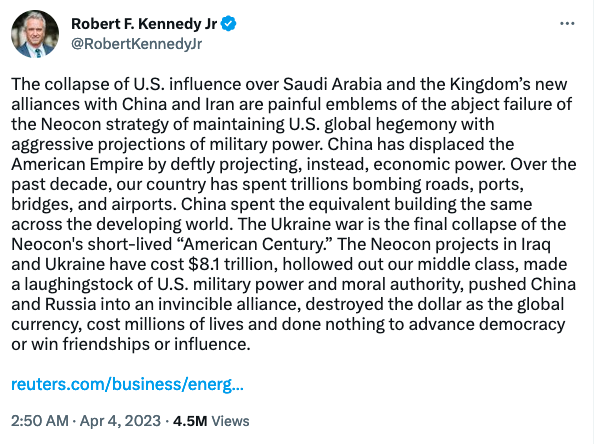
  • Robert F. Kennedy Jr., the nephew of John F. Kennedy and outspoken activist on vaccine injection risks and what some might call a “conspiracy theorist” announced he plans to challenge Biden for the Democratic nomination.

    Not long after announcing his bid for the American presidency, Kennedy shared some thoughts that referenced the end of the dollar:
Business, econ, finance etc:

  • The Wall Street Journal speculated that Elon Musk was planning to revisit his PayPal days by turning Twitter into a payments company in order to achieve the $250bn valuation target he had set for the company.
    .
  • Claudio Borio and Agustin Carstens, both of the Bank of International Settlements, called for a new way of modelling inflation based on a “transition” framework. In the piece they note that the surprise return of inflation has highlighted limitations of the current analytical frameworks typically used to understand and forecast inflation.

    Something, something about how our models failed us, which means we need better models with the capacity to split inflation into different regimes, you know, like water going from frozen to liquid to gas phases. So we should have different rules for a low inflation regime and a different ones for a high inflation regime. [And perhaps when that fails us, we will move to treating inflation like dark matter?].

    JP Morgan’s Jamie Dimon arguably framed it a bit better when he told shareholders in his annual letter this week  that “We may have gone from a savings glut to scarce capital and may be headed to higher inflation and higher interest rates than in the immediate past,” and that “essentially, we may be moving, as I read somewhere, from a virtuous cycle to a vicious cycle.”

    All of this is more colloquially known as the rule of what goes up must come down. – IK

  • The central bank of Curaçao and Saint Martin used its gold revaluation account to cover losses.

    The move comes after the Dutch central bank Governor flagged last November that a revaluation in the price of gold could be used as a solvency backstop in the face of mounting central bank losses. – IK

  • Oops! Kenya lost two tonnes of gold worth Sh15.1 billion ($112.2 million) en route to the Dominican Republic.
    .
  • A Wharton economist spotted that a $7 billion payment had shown up in the filings of the United States Treasury Department, the highest single-day collection since 2005. This sum suggested that either an American billionaire worth up to $17.5bn had died — and that nobody noticed — or that a $17.5bn gift had been granted. Originally thought to have been an error, both a Treasury and IRS spokesman has confirmed its legitimacy.

    It wasn’t the Queen was it? – IK

  • Google announced it would achieve ‘multi-year’ savings by cutting down on employee laptops, services, and staplers!!

  • The International Monetary Fund published their country mission assessment of Switzerland and noted that “risks are tilted to the downside.”
    .
  • Jamie Dimon said governments might need to invoke “eminent domain”, a government approved form of property appropriation, to support greater investments in climate-friendly energy initiatives.
    .
  • FX fintech Wise continued its assault on traditional finance by announcing that its Wise Platform would be working with Interactive Brokers to give their customers the ability to “pay with wise”.

    Silicon Valley Bank UK’s downfall became Wise’s windfall as a flood of distressed SVB depositors ploughed money into the likes of Wise and Revolut, whose lighter-touch onboarding procedures meant they could open accounts for new customers quicker than conventional banks.

    The timing couldn’t have been better for Wise who had just in December launched an interest-generating product for depositors to hold their money in.

    Wise later expanded the service, which it offers in euros and pounds, to France and Spain under the “Assets” brand. The pitch in the press release said it all: The group manages over 10bn euro worth of float globally – and all this money can now be put to work in its interest-rate product (which will soon also be taking dollars).

    At face value this is another move by Wise to show-up the “evil”  banks (as well as the likes PayPal) who are shamelessly failing to pass on higher rates to savers. Digging deeper, however, it’s also a push — perhaps inadvertently? — towards a narrow banking model.

    As Wise’s latest press release about the service noted: “Customers have full transparency of how their money is being used and any change in a central bank rate will be automatically passed on to customers so if the rates go up then so do the returns.”

    But it’s the quote from founder Kristo Kaarmann that is particularly eye-brow raising (our emphasis):

    “Until today people and businesses had the option of bank current accounts that don’t pay interest or to lock money up in saving accounts. Through our first asset “Interest” you take advantage of the current interest rates and earn a return, while you keep unrestricted access to your money for spending. Unlike banks, all of your money is ultimately backed by European and UK government assets”

    A lot of (cash-rich) customers will no doubt love this. Some have even argued to me that they prefer it to giving their money to banks, which mostly use the  to prop up the housing market.
    But this might be a short-termist way of looking at things.

    Lightly regulated narrow banks (because that’s what these are) obviously have the capacity to undercut banks on interest and FX fees because, unlike banks, they don’t have to worry about outsized compliance and capital costs, credit deterioration risk that they need to provision against or even the cost of providing free bank accounts. That means it’s not really a fair race.

    What’s more, it’s not like narrow banks are necessarily less risky – they still have to manage duration risk, especially if, like Kaarman envisages, their products really are geared around unrestricted last-minute access.

    So what’s really on the table isn’t innovation as much as a step back in time to the days of the girobank. And if that’s the case why go through an intermediary like Wise at all? Why not invest in a national savings product directly instead?

    There are other economic issues to consider too. For one thing, it’s hard to imagine how Wise can make any money from the offer at all — especially if it doesn’t charge depositors fees for managing accounts.

    If that’s the case, then it — just like Silicon Valley Bank, which was one of few American banks that prided itself on not charging account fees – will be forced to search for margin elsewhere. The second point is a broader Gosbank one.

    If you’re not funding the private sector via the conventional banking system in an economic model that relies on intermittent failures and bankruptcies to keep it on track, you’re funding the government and thus engaging in gosbanking. That de facto means assigning capital allocation entirely to the government, and hoping the ballot box can do the job of correcting bad allocation instead of bankruptcy.

    That’s not a problem per se. A country like the UK will certainly benefit from encouraging more domestic investors in its bonds. But there’s no escaping the fact that this still amounts to a capital transfer from private sector lenders to government spenders.

    That might prevent banks from overly funding the mortgage market and unnecessarily driving up house prices, but it will also prevent the market from responding to those high prices with additional supply. Instead the housing market would become entirely dependent on the government deciding to build more social housing. But can we really depend on the government to do that as efficiently as the private market? Depends on the government, doesn’t it?

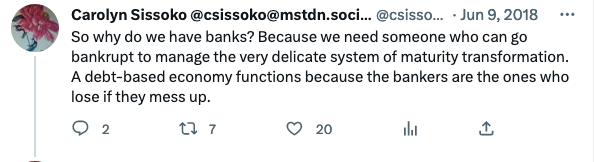
    As economist Carolyn Sissoko neatly put it on Twitter this week, it’s always the same misunderstanding that seems to convince people to turn to narrow banking in moments of financial instability:
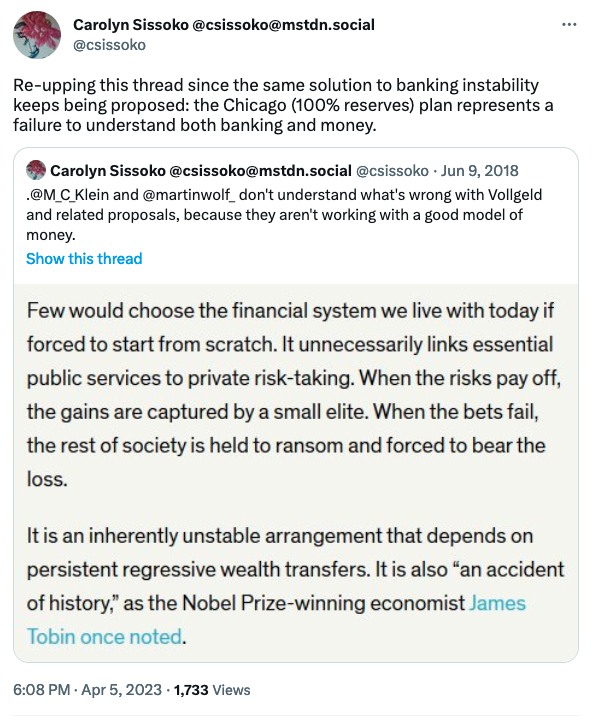
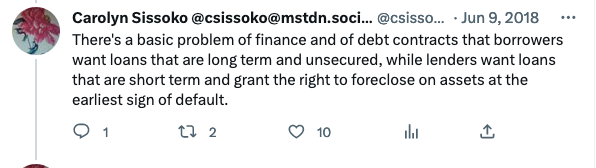
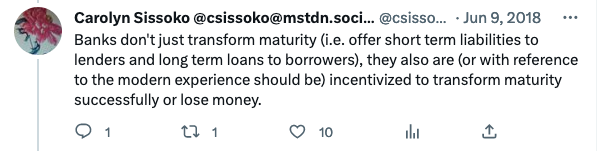
    And here are some great points from her old 2018 thread that still very much apply:

    And this one:
    And this one:
    And this one:
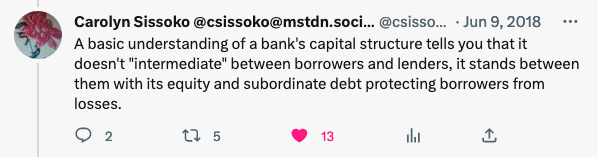
    You know, just read the entire thread.
     

Black Ops Capital:

  • The Pentagon claimed that bank runs were a matter of national security, hinting that the Pentagon’s new Office of Strategic Capital, which was established in December to “counteract the investment power of adversaries like China in US technologies, and to secure separate funding for companies whose products are considered vital to national security” could be used to provide emergency loans and guarantees when strategic assets become compromised. Its exact funding and the extent of its powers are as yet undefined.

    Back in March, 2012, I had the opportunity to be part of an intimate investment gathering in New York that featured an exclusive fireside chat with a former CIA director. Let’s call him T. He explained that investment, technology and national security must operate in tandem to guarantee the hegemony of any state.

    No shit, Sherlock – you might say. This has been apparent since the days of the Manhattan project if not the days of the Medici.

    That may be so. But most investors and market practitioners remain siloed in their niches and neglect to consider how this reality can influence markets more broadly, especially with respect to how the private sector, the public sector, national security and investment interoperate in the modern age.

    What T pointed out that day was profoundly obvious in hindsight. Open sourcing and the internet had transformed the way black ops research and development had to be done. It could no longer be consigned to secret labs behind locked doors. These days, if projects are overly contained, they are likely to be disadvantaged by a lack of access to the collaborative and scaled-up learning processes that advance technology by encouraging feedback and iteration. That’s why almost every government sponsored tech project must have an element of dual use to it — simultaneously public and national security facing. In scenarios where secrecy remains of paramount importance, meanwhile, it’s clear too that different tactics must be used. The aim is not to conceal the work, but to hide it in plain sight.

    It was this understanding that ultimately turned the CIA into a venture capitalist and tech incubator under its Peleus/In-Q-tel arm — seeding businesses that could be deployed for civilian purposes but also weaponised if needs be for national security purposes. Economist Mariana Mazzucato might describe the phenomenon as the manifestation of the entrepreneurial state in its most acute form.

    In such circumstances the job of the clandestine services, if any, is to muddy the waters. Promising tech firms with great weaponisation/defence potential must be portrayed as being anything but (so that enemy states don’t invest as much in the same technology) while useless tech firms that are mostly costly resource sinkholes, must be made to look more promising than they are to lure enemies into expending resources wastefully and getting nowhere.

    The question investors should continually ask themselves given this reality is how much of the tech space represents organic private sector entrepreneurial activity and how much of it represents government agency-led innovation for national security purposes at arm’s length? Which tech billionaires are therefore front men for the agency? And which are not? Equally, how exposed is the broader tech sector to a sudden removal of that taxpayer/government support — either because the public purse can no longer afford it or because there’s been a democratic backlash against it? (In both cases because the tech has actually failed to deliver productive growth?)

    Finally, it’s important to consider what happens if nobody can tell the difference anymore between truly productive and virtuous innovation that everyone wants and benefits from and statecraft-led innovation, driven and guided by very different objectives? What does it mean when everyone is working for the government in some round about way?  – IK

  • Eric Weinstein, mathematician and managing director at Thiel Capital, appeared on the Joe Rogan show in February and talked about Black Ops Capital.

    It’s a four-hour recording, but the highlight comes about an hour in when Rogan and Weinstein discuss UAPs and Weinstein ponders how a government agency could in this day and age fund and operate a Manhattan Project-scale stealth project without the secret being exposed?

    A key requirement, he notes, would be for the project to be able to benefit from off the books financing. In that respect there are four notable investment firms/personalities that he says he could never make heads or tails of because their performances were just too good to be true — hinting that something else must be going on. The first two, Bernie Madoff and Jeffrey Epstein, turned out to be Ponzis and criminal enterprises. But the second two, D.E. Shaw and Renaissance Technologies, continue to operate.

    Of those two, Weinstein notes, Renaissance Technologies — home of Medallion fund, the world’s most successful fund — has the greatert potential to be involved in something more, err, significant. First there’s the fact that Rentech founder Jim Simons is a legit former NSA guy. Second there’s the heavyweight political gifting that goes on, with both Simons and former co-CEO and AI-expert Robert Mercer giving away huge fortunes to political parties (on opposing sides, we might add – which is obviously a nice power hedge). Third there are the links that former Rentech employees reportedly have to mysterious “destablising” groups like Epoch Times and SCL (of Cambridge Analytica fame).

    Finally there are Simons’ own links and donations to Stony Brook University, which Weinstein notes would — if he had the choice — be the best university to position a group of scientists and academics that operate fluidly between the academic and stealth agency worlds.

    What Weinstein was hinting at, of course, is that Medallion’s outsized returns are less luck and skill and more information advantage linked to a “cosy” relationship with the National Security Agency. Is there any concrete evidence for this? Of course not. But then again there obviously wouldn’t be either.

    Which does make you wonder about the degree to which the investment space could be populated by “licensed” cutouts focused on monetising the government’s information advantage in the marketplace. Nancy Pelosi’s active investing record certainly gives food for thought.

    Given that other states run sovereign wealth funds powered by oil wealth, it’s fair to ask why shouldn’t the United States operate a sovereign wealth fund that’s powered by data wealth? Immoral it may be. Illegal for the most part too. But exceptions already apply in the case of financial and monetary stabilisation efforts.

    The real issue with deploying privileged government information in this way is the lack of transparency and public say over how the profits should be spent. The potential abuse of power such a situation could engender is clearly problematic. The counter argument, though, is that transparency would make any strategy less effective. Also, if things did go wrong — say because a virtuous circle became a vicious loss-generating one — the public liability would be limited.

    Either way it’s fun to speculate about the true nature of what the brainiacs at Rentech are really working on is. And why all the secrecy?

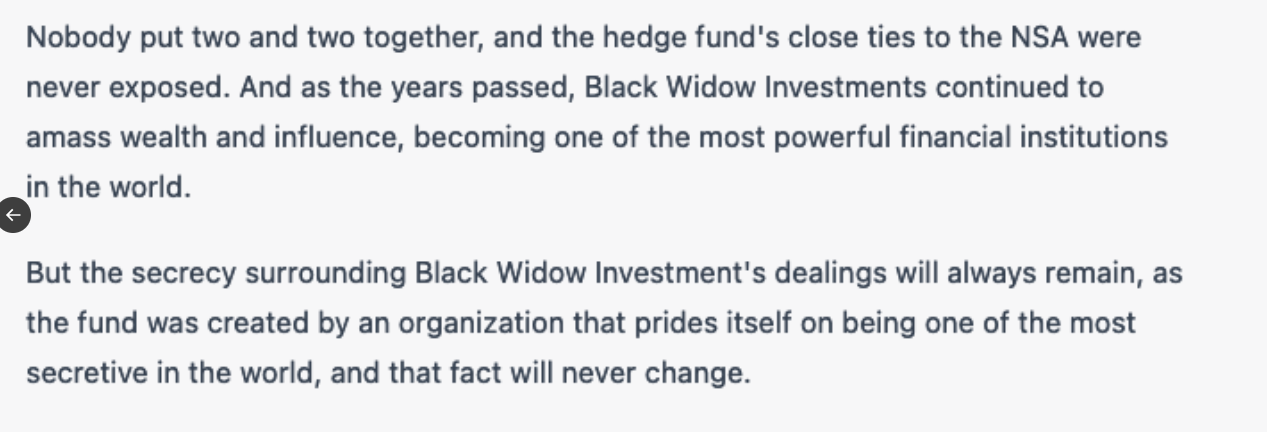
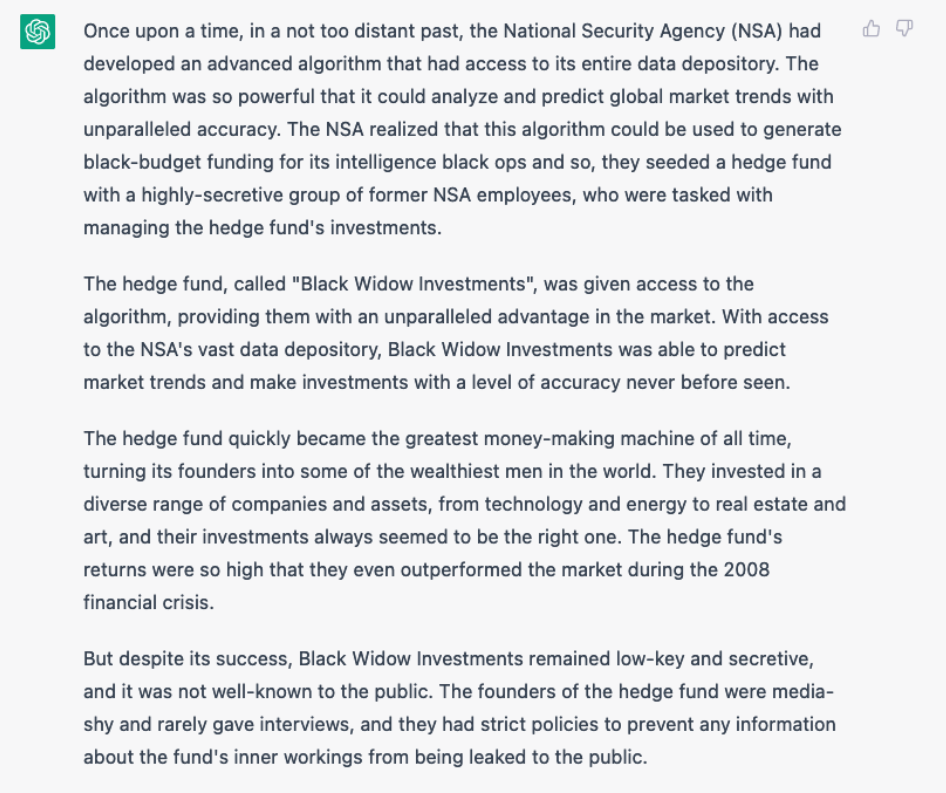
    If they’ve cracked quantum, or are about to crack it, there may be huge implications for markets. For more on that do see this piece I wrote about it for the FT. In the meantime, there’s a lot of fun to be had with ChatGPT if you ask it to imagine a narrative where a stealth government hedge fund is used to fund all sorts of black ops. Here’s one example from an input I put in back in January, 2023:

  • Also in February, Sifted published a deep dive into the economic monster that is Bbifrance, the French state-backed bank which supposedly has fingers in every corner of the French innovation ecosystem.

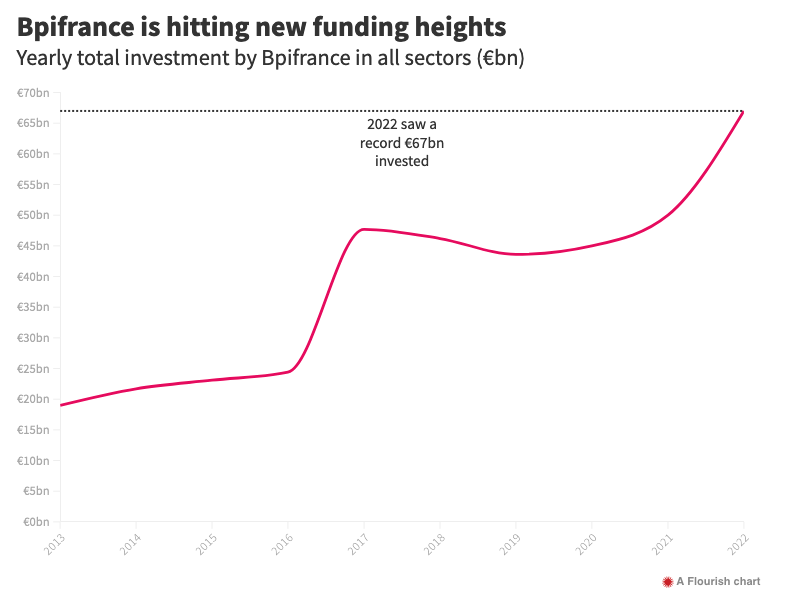
    In another example of the state coming to the rescue of the tech sector following the evisceration of venture capital due to high interest rates, Bpifrance pumped €67bn into France’s economy in 2022 through a vast array of investments, loans, financing guarantees and export insurance.If that chart doesn’t give you a sense of the current Western desperation to innovate, we’re not sure what will. The funding mood is evocative of the old Space race — almost like the future of the Western world depended on it.
    The story of Bpifrance’s funding of quantum start-up PASQAL is a case in point.

    From Sifted: “Bpifrance’s Rolodex of contacts and introductions facilitated the company’s [PASQAL] Series A round of $30.5m in June 2021. The round was led by Quantonation, a Paris-based quantum VC firm, but also included money from Definvest, the Defense Innovation Fund which is managed for France’s military by — you guessed it — Bpifrance. Other participants in the round included Luxembourg-based Runa Capital, Daphni and US-based corporate venture fund Eni Next.”

    Wilfred Lagarde, who operates at Bpifrance as an undefined project manager, is — based on our preliminary research — the former husband of ECB boss Christine Lagarde and father to her children.

    – IK

  • Researchers from JP Morgan claimed that quantum computing could double the efficiency of machine learning-based hedging strategies, as the American investment bank delves into quantum deep hedging.

Commodity corner:

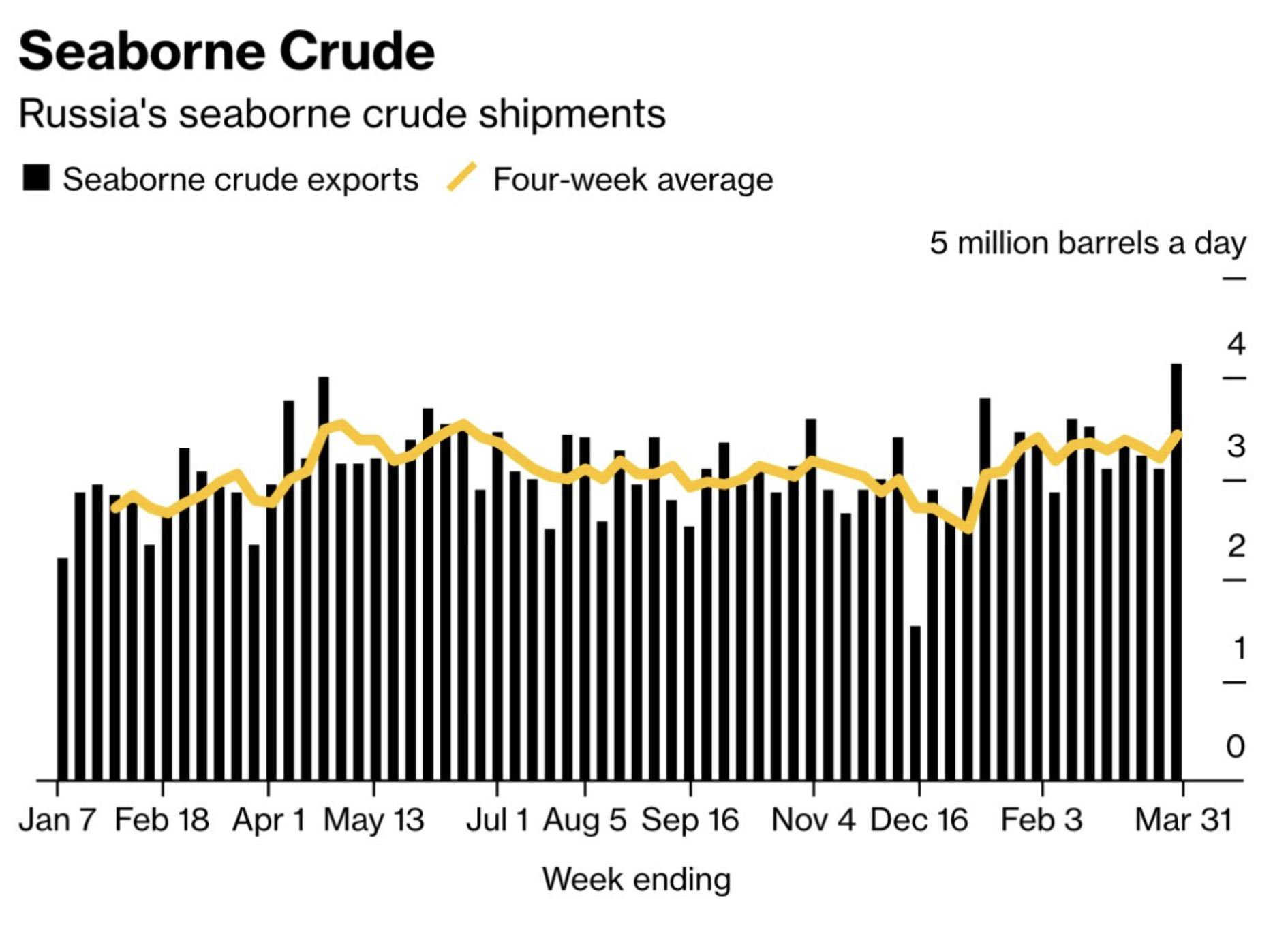
  • Bloomberg highlighted that Russian oil exports were swelling.
  • A discussion in the Blind Spot Discord chat observed that despite all the panic about grain shortages in 2022, these had turned into grain gluts and protesting Polish farmers.

    The Polish grain gluts have manifested because Ukrainian grain is having to be transported in much greater volume by train into central Europe instead of to emerging markets like Egypt via the Black sea.

    Things would have been much worse, by the way, if not for the deal Russia struck in October with Turkey to allow grain shipments via the Black Sea on humanitarian grounds.

    Even so, major choke points persist — especially with respect to dislocations related to quality and grade of grains being exported. Much of the grain coming out of Ukraine is of a lesser quality, hence its appeal to poorer countries like Egypt. But with the cheaper stuff now finding itself heavily discounted in central Europe in a bid to incentivise arbitrage to get it shipped out via different means, this has had a price impact on imported volumes into Egypt feeding into Egyptian inflation.

    Egypt’s inflation rate hit 31 percent in February prompting a 200 basis point interest rate hike. In recent days Egypt has done deals with Russia to avert its crisis. Poland, meanwhile, has now temporarily suspended grain imports from Ukraine on Friday. – IK

  • Pakistan, another big historic importer of Ukrainian grain, experienced its highest-ever annual inflation reading of 35.37 percent as 16 people were killed in a food stampede.
    .
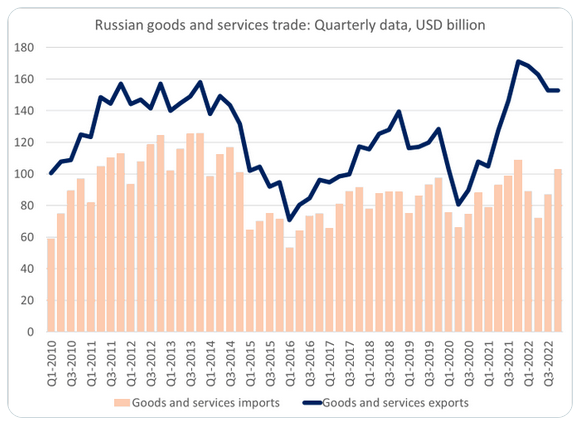
  • CFR’s Brad Setser spelled out the obvious about Russia’s balance of payments and why the country is so difficult to sanction; it needs a fraction of export proceeds to cover its import bill, and the world requires its exports of commodities and energy. [But why did it take economists this long to figure this out? – IK]
  • Louis Dreyfus said it would cease exporting Russian grain from July 1. The Russian Agriculture Ministry has claimed the move would not affect the volume of Russian grain exports. Louis Dreyfus is the latest departure from the Russian grain market following the exit of Cargill and Viterra last week.

    This is not without some caveats, however. Cargill’s shipping unit will continue to transport Russian grain, while Viterra’s local management team will create a new trading firm. Regardless, the move is certain to reinforce Moscow’s stranglehold over the global wheat market. – DGG

Crypto evangelism:

  • The price of  Ripple (XRP) surged on speculation that its case with the SEC would soon be resolved. But CoinDesk suggested XRP could also be benefiting from large capital inflows from Korean exchanges.
    .
  • The European Economic Governance and EMU Scrutiny Unit released a paper on the digital euro that revealed the ECB will decide on the issuance of a digital euro by 2026.
    .
  • Bjarke Smith-Meyer at Politico directed readers of the morning newsletter to a European Commission document which revealed that banks and payment companies could charge shopkeepers a fee to finance the cost of distributing the digital euro. You can read the full document here.
    .
  • Argentinian airline Flybondi announced it would be issuing every ticket as an NFT and that the format would allow passengers to “change names, transfer, or sell their tickets independently”.

The secondary market for airlilne (and other) ticketing is clearly a sector in need of innovation – and, who knows, perhaps this is where the tokenisation of tickets can really come into play?

Take Eurostar tickets as an example.

They are famously inflexible and expensive, which means when plans change, it is sometimes easier to sell a ticket outright on the secondary market than it is to pay a fee for an amendment. This has led to a large and flourishing Eurostar ticket secondary market.

This secondary market is primarily organised on French-speaking Facebook groups, where individuals buy and sell their tickets to and from strangers online. However, scams and untrustworthy buyers and sellers abound.

In a bid to bring order to the market, a few years ago, some friends of mine set up a website dedicated to trading Eurostar tickets. It was an instant hit. But after three months of incredible outsized revenues, they were predictably faced with a cease and desist from Eurostar, which clearly would prefer to maintain all the profits from transfer/cancellation fees itself. Understandable to a degree. But the problem with never allowing a secondary market to come about is a general lack of price discovery on short-term ticket imbalances.

Perhaps tokenising tickets could help with that? If it did that could mean the end of overbooking, which currently amounts to the fractional reserving of commuting. – DGG

  • The Federal Reserve revealed that FedNow, the Federal Reserve’s digital payment system, would launch in July this year. The system should allow money transfers, bill payments, and other consumer transfers to process more efficiently and at a lower cost.
    .
  • I argued it might be time to replace the BoE’s Andrew Bailey with ChatGPT.

Media matters:

  • Substack revealed absolutely atrocious figures for 2021 as part of paperwork it had to file to access over $5 million worth of funds raised from its writer community. The subscription service burned through over $25 million of funds in 2021, spending over $10 million on salaries and over $5 million on prepaid deals with writers. None of this comes as a surprise to The Blind Spot.
    .
  • Twitter Files journalist Matt Taibbi said he was leaving Twitter following the social media’s clampdown on sharing Substack links, after it announced it would be launching a short form version called Notes that aimed to compete with Twitter.

    While both Twitter and Substack fight it out to the death, we’re inclined to bring Innscribers — our idea for a professional journalistic platform that competes around standards — to market at a fraction of their start-up costs by leveraging ChatGPT. Unlike the heavily indebted incumbents, Innscribers has an immediate monetisation plan and benefits from being free from debt. In an ideal world, Innscribers will also be owned by its members and writers from the very beginning too. The main stumbling block for Innscribers so far has been an inability to raise financing due to the simple fact that it’s super conflicting for a journalist to go around hustling for cash. But with ChatGPT finally here, perhaps if we build it on the cheap, they will finally come? – IK

  • Elon Musk put Twitter’s recommendation algorithm’s code online. Users can submit a suggestion alongside the suggested code to integrate user feedback into the design of Twitter’s recommendation feed. Twitter users have found some curious submissions, such as a code modification to remove recommended tweets from TwitterBlue users.
    .
  • Jacob Siegel expanded on how Obama’s 2016 effort to combat disinformation with the obscure Global Engagement Center fundamentally changed the nature of social media, by permanently blurring the distinction between citizens and terrorists online.

Geopolitical pivots:

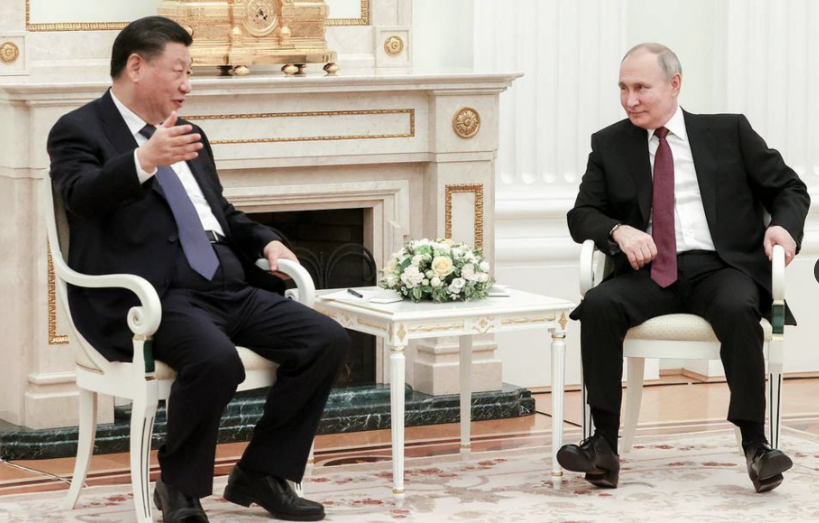
  •  China’s President Xi gave Ursula Von der Leyen a muted welcome when she arrived in Beijing relative to that of Macron, for whom he rolled out the red carpet, in a bid to play divide and conquer with Europe.
    .
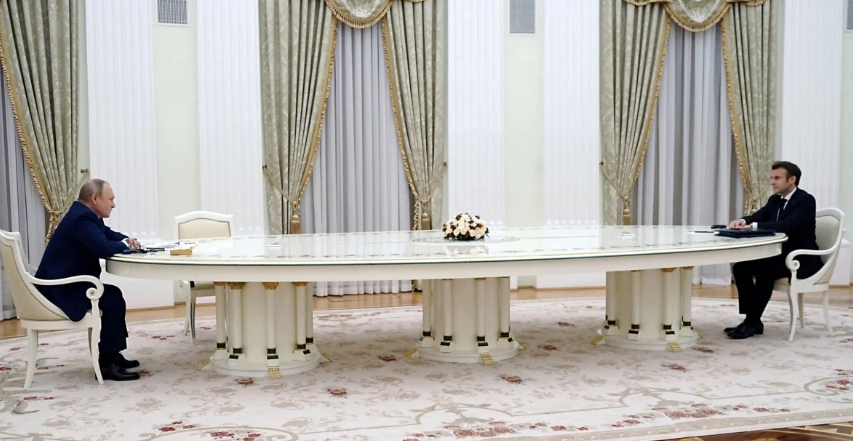
  • The long table meme struck again:

    .
  • The Russian prankster duo that previously caught Ursula Von der Leyen and Christine Lagarde out set their sights on ex-French President Francois Hollande. In a call with one of the duo, pretending to be former Ukrainian president Pyotr Poroshenko, Hollande claimed that “we (the West) managed to overthrow Yanukovych,” and that the Minsk Agreements were about arming Ukraine in a play for time.
    .
  • The German military bizarrely channelled Sith energy and Darth Vader at their space command launch.
    .
  • ProPublica revealed embarrassing details about Supreme Court Justice Clarence Thomas‘ unprecedented and undisclosed holidays abroad on the yachts and private jets of billionaire and Republican donor Harlan Crow. The series of luxury escapades also included one to Bohemian Grove.
    .
  • The International Court of Justice ruled that the United States violated a 1955 treaty with Iran in freezing Iran-related assets following alleged American violations of the treaty since 2002. Though the United States formally withdrew in 2018, the court found the disputed actions occurred while the treaty was still in force, meaning the US could be liable for compensation.
    .
  • Despite Ukrainian protests, Russia has assumed the rotating Presidency of the UN Security Council. The mostly procedural role does have some minimal powers, including overseeing a public debate regarding a “new world order” that would “replace the unipolar one”, according to the Russian Ambassador to the UN.
    .
  • China’s Fujian maritime safety administration said it intends to monitor and board ships in the Taiwan Strait, while Taiwan claims it won’t cooperate.
    .
  • Saudi Arabia led efforts to welcome Bashar al-Assad’s Syria back into the Arab League in defiance of US warnings not to do so. The move came as both the United States and Israel launched airstrikes in Syrian territory, amidst a visit of the Syrian Foreign Minister to Cairo.

You’re either in power or in prison:

  • Former Pakistani PM Imran Khan was escorted into the Lahor courthouse wearing a supposedly bullet-proof black bucket hat.
    .
  • Nicola Sturgeon’s husband was arrested following an ongoing probe into SNP finances. The probe is trying to clarify how £600,000 of SNP funds for the new independence referendum have been spent, considering there is currently no independence referendum underway.
    .
  • German Chancellor Olaf Scholz faced a parliamentary investigation over the German cum-ex tax scandal.

The UK is or isn’t a basket case?

  • The Comprehensive and Progressive Agreement for Trans-Pacific Partnership (CPTPP) formally accepted the UK into the group as of March 2023. The UK had applied to join it in February 2021. But analysts warned the deal would only boost GDP by less than 0.1 per cent.
    .
  • UK service providers recorded a sustained expansion in export activity in March, caused by the fastest increase in new order volumes in a year, and the strongest rise in new export sales in the survey’s history.
    .
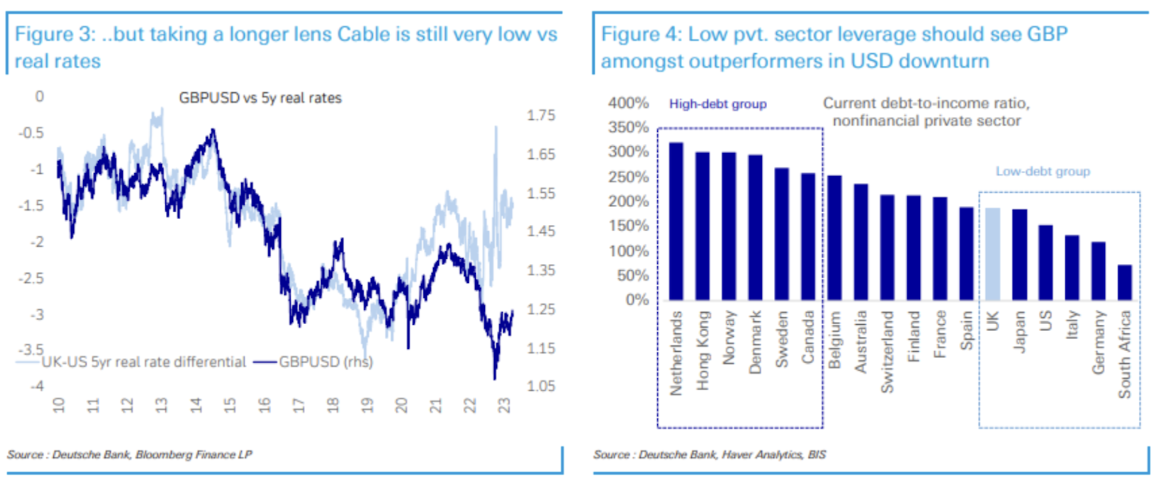
  • Sterling hit a 10-month high and the UK press finally noticed.

Cast your mind back to September 28, 2022 when Liz Truss’ micro tax giveaway had freaked out the world, caused a gilt sell-off and forced the IMF to warn about the stability of Britain. Even Credit Suisse – oh the Schadenfreude – had got in on the UK bashing act. The verdict from the inexplicably self-loathing British press was fairly unanimous: Britain is now a basket case.

The Blind Spot cared to disagree, however. On Sept 29, two days after the bottom was set, we urged our readers to #standwithGBP.

Are we forecasting geniuses who can see into the future? No. We merely listened to some good advice from those who have spent “a long time in finance”.

As former Telegraph finance guru turned podcaster Neil Collins told our Markets Live session on Sept 28:

Turns out he was right:

Making the standwithGBP call wasn’t rocket science, it was just an obvious interpretation of market sentiment and psychology, which by that point had completely succumbed to group-minded panic.

These sorts of sure-bet counter groupthink trades are usually few and far between in a professional trading lifetime. But if you happen to spot them (and it’s often those who have been around a bit who can see them for what they are) they’re often career making.

That the majority of the British press went all in on the panic was frankly another clearcut indicator. 

There are two important (and frankly age-old) lessons for investors to takeaway from the above.

The first is to remind ourselves that on occasions hysteria can indeed influence reality (a la Credit Suisse) – so it doesn’t matter if you are technically right about the tier one ratios and liquidity positions. If the market wants it, it will have it. Doom-loops are self-fulfilling.

The second is to remind ourselves of the importance of being conscious of our own hysteria because systems are often more resilient than we appreciate them to be, and we humans have an amazing capacity to come together and defy the odds.

In that vein, while the Blind Spot has been very right on sanctions not being more harmful to us economically than Russia – it’s also the case that our fears about winter rationing were entirely overdone. It could be that we haven’t seen the worst of it yet, but at this point, I daresay, the West’s transition to a multipolar economy – if it does indeed happen – will be more boiling frog than collapse of the USSR. – IK

  • The Australian central bank governor Philip Lowe observed that higher interest rates were not passing through to the UK economy as strongly as other economies.

  • George Saravelos at Deutsche Bank Research, previously very negative on GBP, changed to a bullish view on the back of a more broadly negative dollar outlook.

Politico’s finest:

  • The Conservatives awoke to a new election battleground: sewage-strewn beaches. Tory MPs allegedly fear the water cleanliness issue may cost them in upcoming local elections, particularly those in coastal and rural seats.
    .
  • Rumours abounded in Brussels that NATO’s Presidency may be handed to Ursula Von Der Leyen. Jens Stoltenberg is set to leave his position this September. His successor, whoever they may be, will have to be more politically neutral, sensitive, and high-profile than at any other point in the past.
    .
  • Due diligence firm Mintz Group’s Beijing offices were raided on April 5, with all five of its Chinese employees there being arrested by local authorities.

The raid and arrest of Mintz Group’s office and employees highlights the occasionally extremely sensitive nature of private intelligence business. 

The exact reasons for the raid are unkown – but it’s not the first time such a thing has happened. Politically motivated commercial raids have become commonplace in China since at least 2013, especially against American companies.

When the Blind Spot asked a contact who is close to the Mintz Group about the raid, they noted: “It was kind of mental (…) what I have heard is that they (maybe) had advanced warning and may have managed to get some staff out to Hong Kong.”

Mintz Group is a respected intelligence and background check provider. It is also one of the few Western companies in China that is almost entirely staffed by Chinese citizens, our source added.

The notable exception to this staffing policy was the head of Mintz in Beijing, one Randal Philips. As listed on his linkedin, Philips became the Managing Director for Asia in 2011, the same year he retired from the CIA as their Chief CIA and National Intelligence Representative in Beijing. “I always felt like  (Randy being ex-CIA) was a bit on the nose (…) if I was in the Chinese government I’d think ‘what the fuck’.”

Asked about the consequences of this raid, our contact said: “It raises questions in terms of how western companies can go about doing their business in China. It obviously shows these activities are hitting a bit of a nerve. Either the person they targeted was massive, or the authorities have tired of it.”

Either way, the incident shows that Western companies looking for an intelligence leg-up in China should consider eyeing geopolitically neutral intelligence companies. – DGG

Covid collateral:

  • In 2020, Professor Sunetra Gupta was widely mocked for suggesting the Covid Infection Fatality Rate would be close to 5 in 10,000. Three years later, Danish data suggested the real figure at 6.5 in 10,000 was very close to her estimate.
    .
  • Official figures from the Australian Bureau of Statistics revealed that Australians were dying at an ‘excess death’ rate that only compares with World War 2. According to the data, 2022 saw excess mortality running 15 per cent above the expected number of deaths. Of 25,235 excess deaths in 2022, only 10,095 were directly caused by Covid.

The Daily Blind Spot newsletter

Latest posts

Leave a Reply

Your email address will not be published. Required fields are marked *