

Startling news regarding insane price increases in electricity bills have pleased few. According to Citi, the UK inflation rate will hit 18 per cent in early 2023, while Ofgem announced the average household bill will increase to £3,549 a year from October 1, 2022 – 2.5 times higher than last year.
Stories like that of a Leicester City café seeing its energy bill go up by £45,000 a year (which is apparently the average price increase for small shop owners) have become increasingly common.
Here’s another example:
Here’s mine. I have two meters in my business. Jointly, currently, £21,000. Quoted to go to a combined £91,000. What on earth do I do? 🤷🏻♂️ pic.twitter.com/DSlK7nQDly
— Premier Seafoods Ltd / kingcrab.co.uk (@Premierseafoods) September 2, 2022
This insanity has led the Association of Convenience Stores, which represents 48,000 local shops, to write to the British chancellor claiming the sector needs a £575mn support package to stay afloat. Though “ACS does not usually forecast large-scale closures of convenience stores, we are in all seriousness doing so now”, claimed ACS chief executive James Lowman.
Many consumers and small businesses are turning to campaigns and bill strikes such as “can’t pay, won’t pay”. In practice, few solutions to surviving the upcoming energy shortage in the UK exist. Those knowingly trading insolvent, meanwhile, risk losing their limited liability.
Contingency planning
With Whitehall now formally creating civil service contingency plans for blackouts, that should make the generator industry — a staple in developing countries — of sudden and notable interest to more than just camping and recreational vehicle (RV) enthusiasts in the West.
Figures from Grand View Research released before the popular understanding of energy shortages was even a thing already had the generator sector growing at a compound annual rate of 8.5 per cent. If things really do turn out as bad as expected this winter, that could see the current estimate of $38.5bn by 2030 easily surpassed.
The fastest growth rate was forecast in the Asia Pacific region, particularly China and India. Major players in this industry are; AKSA power generation company, Atlas Copco AB, Caterpillar, Cummins Inc., Doosan Portable Power, Generac Power System Inc., Honda India Power Products Ltd., Kohler Co., Rolls-Royce plc.
Already in May, Grand View was noting a clear escalation in demand for emergency power backup and stand-alone power generation across several sectors of industry.
Either way, whether you are a household or a business, it has never made more sense to own a generator. Take as an example the UK’s McGill’s Buses which, having recently purchased 68 new electric buses, has now discovered that charging buses with diesel generators is actually cheaper than purchasing electricity from the grid.
However, the Blind Spot’s own investigation has not found that large-scale industry is leading this charge in growth – not in the UK at least.
Instead, it is homeowners and small businesses squarely determined to keep the lights on during these turbulent times. For now, the good summer weather and yet-to-be-received monthly bills are still delaying full recognition of the avalanche that is coming. Even so, supply chain issues at generator manufacturers are already inhibiting the capacity of the industry to service the rise in demand.
“This is like a tsunami that’s about to hit,” claimed one salesperson who wished to remain anonymous, adding “and it’s not just commercial companies, we’re being inundated with home backup requests too.”
Becoming informed on generators now means having the opportunity to purchase one before the inevitable price gouging that will arise in winter. Here is what the Blind Spot has learned about generators, and how to make your pick.
Generating generator expertise
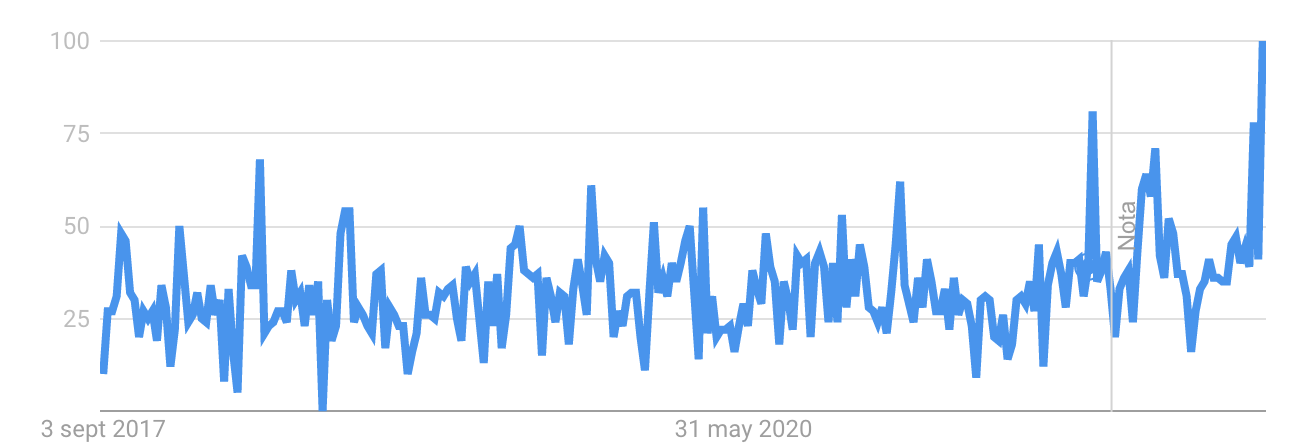
Search trends for generators are almost off the charts, according to Google Trends.
Below are search trends for ‘diesel generator’ in the UK.
The following is for ‘power generator’ in the UK.
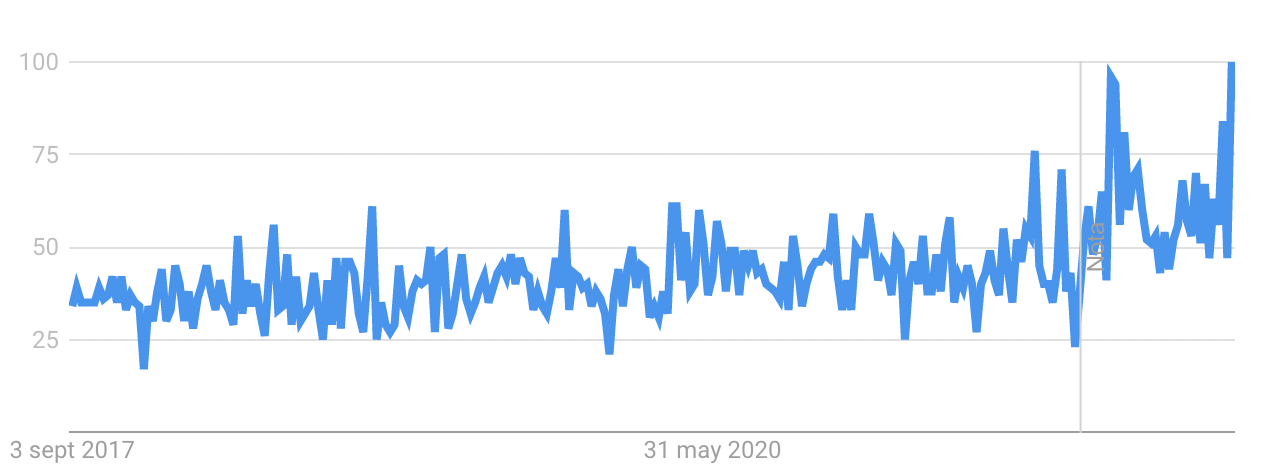
As consumers and businesses receive insane price rises in their monthly bills, expect this interest to continue rising.
Our informal probe into the sector showed households were the number one leading source of new inquiries. “There’s been a lot of customer inquiries for smaller generators such as domestic generators that can be powered easily,” said Stuart Wilson of Woodlands Power, a London-based generator supplier. “Mainly people are worried about blackouts or they’re trying to mitigate against business downtime.”
Complicating the matter are supply chain shortages; “It was pretty rough out of Covid, but then you add Ukraine in the mix… we’d barely caught up with demand as it was!”, said a salesperson at another provider, who preferred not to give their name.
Woodland’s Wilson added that Covid and Ukraine-led supply shortages were leading manufacturers to work around the clock: “There’s a generator shortage in the market and there has been for the last 2 years. The big generator manufacturers are cross-hiring and getting supplies from each other,” which is leading to price increases rather than decreases.
EU emission Stage V-standards, even for systems as small as 19KW — which are only capable of powering little more than outside lighting — have also added to cost pressures.
Vendors complain Stage V-compliant generators barely offer any efficiency gains or emissions savings over standard systems while costing the consumer twice as much. Those operating non-compliant systems, however, are subject to fines from the local council.
The UK government’s ban on red diesel from this April onwards is also set to punish consumers this winter. “Red diesel was the biggest joke, why would the government decide to do that now?”, said one sales persons who preferred not to give their name.
For now, Amazon shows a plentiful supply of small-scale solar and diesel generators suitable for mobile homes and RVs. Costs, however, are probably prohibitive to those on average salaries. On the solar front, it will set you back a minimum of £800-900 for anything capable of powering a small fridge for up to an hour in a blackout. Models capable of doing a 4-8 hour distance, however, start at £2000-£2500, at which point it’s probably worth looking into a permanent solar installation and battery pack. Small-scale diesel-powered generators can still be sourced around the £800 price mark, but this offers no respite from potentially spiraling cost of diesel.
Know your generator
So if you are going to go down the generator route, which should you use? Online power guides are emphatic; diesel is the way. From the guide:
A typical 5-kilowatt gasoline generator that is used to generate power for essential appliances consumes at least 0.75-gal/hour, which is equal to 18-gallons per day. In contrast, a much heavier 20-kilowatt diesel generator used for higher appliances such as heaters and pumps require only 1.6-gal/hour.
Once you’ve made the easy decision for a diesel generator, you must decide on both the size and type.
The more power needed from a generator, the more wattage required and the greater the cost.
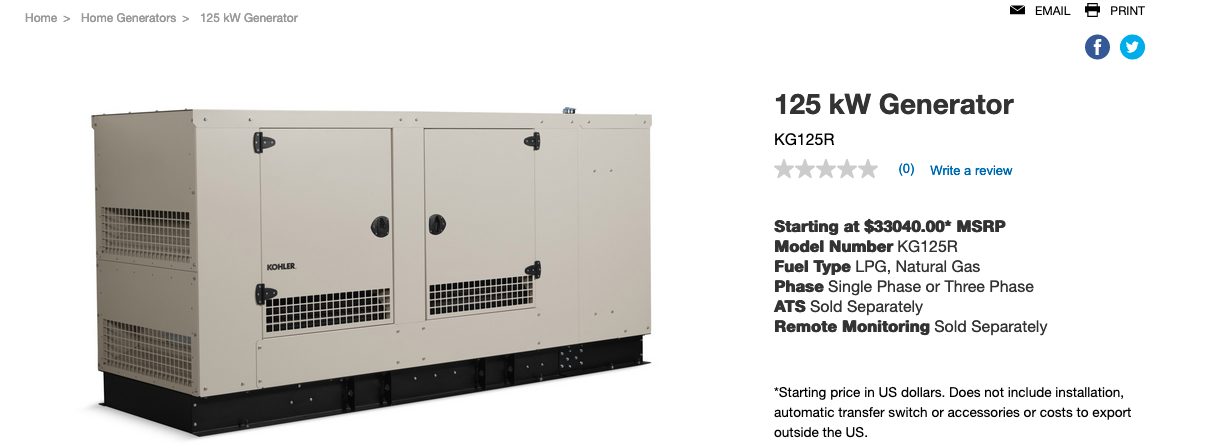
A rough guide is that 12 KW provides enough power for lighting in a small package. 35 KW will do for lighting, sump pump, refrigeration, well pump, and microwave (but not all at once.) A 90 KW unit will power more household functions plus other heavily energy-consuming options like a toaster, oven kettle, and a range top. 125 KW can keep most homes running as normal during a blackout but costs about $32,000, requires professional installation, and is equivalent to the size of a small car:
But that’s not the end of the complexity. Once you have determined the wattage you need, you have to choose the generator design that suits you most: open frame, inverter, or digital hybrid.
Open frame gives the highest wattage per purchase price, so if you just want basic power production for your home and don’t care about noise or variable power output, that’s the way to go.
Inverter generators are more expensive per KW but are quieter, lighter, and more fuel efficient because they vary power output based on the electricity you need.
Digital hybrid models, meanwhile, combine the cost and simplicity of an open frame model, but are quieter to operate, have lower fuel consumption and offer the refined electrical output of an inverter.
Choices for permanent, more immobile generators are easier. These are called backup generators and can be thought of as a permanent fixture in any location. Their role is to activate automatically when the mains come on or off – but which usually fall into the industrial side of the market.
For more on that, check out this handy website.
While geeking out on generators may be fun, perhaps we should start focusing on buying one.
